


How AI Literature Assistants Are Transforming Research Workflows?

The exponential growth in scientific publications has created an environment where researchers are inundated with more content than they can feasibly read manually. A single subfield can produce hundreds of papers in a year, and traditional approaches to literature review — reading, annotating, summarizing, and synthesizing research — have become increasingly time-consuming. In response, a new class of AI-based literature assistants has emerged, designed specifically to augment human capabilities in navigating vast scientific corpora. These intelligent tools leverage advances in natural language processing (NLP) and large language models (LLMs) to accelerate comprehension, reduce cognitive load, and help researchers focus on the most relevant insights.
AI-Powered Assistance in Scientific Reading
Modern AI literature assistants vary in functionality but share a core objective: to support scientific reading rather than replace it. Tools such as Scispace integrate PDF question-answer interfaces with citation-backed summaries that let users ask contextual questions about specific sections and receive precise, relevant responses, helping them grasp technical details faster than through manual reading alone. Scispace’s AI Copilot feature and structured literature review functions illustrate how tools are moving beyond simple summarization toward interactive reading support that can streamline complex research tasks. [1] Other platforms like Semantic Scholar utilize AI-driven contextual analysis to generate “TL;DR” summaries and highlight key points within a research paper, enabling users to rapidly assess relevance before committing to a thorough read.
These assistants perform several functions that enhance scientific reading workflows. Automated summarization condenses key findings, methodologies, and conclusions, which saves time during initial literature screening and synthesis phases. Some tools, such as Iris.ai, employ semantic analysis to map conceptual relationships among papers, helping researchers visualize thematic trends and identify connections that might otherwise be overlooked. [2] Others, like advanced research assistants emerging from academic research projects, are designed to embed expert reading methodologies into their logic. For example, InsightGUIDE is an AI assistant developed to provide structured, concise insights that act as navigational “maps” through complex scientific articles, focusing on actionable guidance and facilitating deeper comprehension.
Another dimension of AI literature assistants is their ability to handle multi-document synthesis. Tools such as Elicit offer semantic search over large databases of academic papers, extract structured data from PDFs, and even generate editable research reports that mimic aspects of a systematic review. These capabilities can dramatically reduce the time required to compile and compare evidence across studies, which is especially beneficial for large-scale reviews or interdisciplinary work where researchers must survey diverse literatures. [3]
Impacts on Research Practice and Critical Engagement
The integration of AI assistants into scientific reading workflows is reshaping how researchers interact with literature. At the most foundational level, these tools are enabling faster discovery and prioritization of relevant work. Semantic search mechanisms can interpret research intent beyond keyword matching, retrieving papers that might not surface in traditional database queries. [3] This enhances the efficiency of literature discovery, allowing researchers to allocate more time to critical analysis and hypothesis generation rather than exhaustive manual searching.
AI literature assistants also support deeper engagement with content through interactive query interfaces and contextual explanations. By enabling question-driven exploration of research papers, tools like Scispace and others with interactive features reduce barriers to understanding dense technical material. Researchers can probe specific aspects of a paper — such as a statistical method or a result interpretation — and receive targeted summaries or explanations without having to read every section line by line. [1]
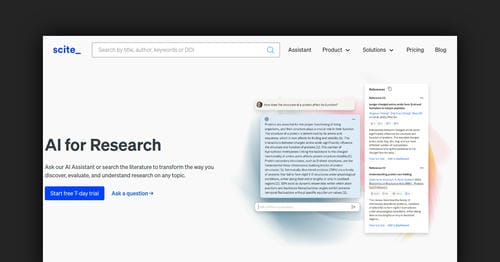
In some cases, AI can aid in evaluating the quality and impact of research. Tools such as Scite go beyond citation counts by classifying how a paper has been cited in subsequent literature — whether supporting, contrasting, or simply mentioning the original findings — which helps in assessing a study’s influence and reliability. [4] This contextualized citation analysis can inform researchers’ judgments about which sources merit deeper scrutiny or inclusion in a review.
Despite the clear utility these technologies offer, they also raise important questions about the role of human judgment in scientific reading. AI summarization and synthesis can reduce the time to first understanding, but they do not replace the critical thinking and contextual knowledge required to interpret research findings accurately. Experts caution that reliance on AI summaries must be balanced with careful evaluation of source material, as AI tools may overlook nuances, bias from training data, or interpretive subtleties that are evident only through close reading. [5] This underscores the importance of viewing AI literature assistants as augmentative tools that enhance efficiency and comprehension, rather than as substitutes for expert reading and critical assessment.

Beyond individual workflows, AI-enabled literature assistants have the potential to democratize access to scientific knowledge. By simplifying complex content and providing structured entry points into specialized research, these tools can lower barriers for students, early-career researchers, and interdisciplinary scholars who might otherwise struggle with dense technical publications. Moreover, platforms that integrate knowledge management features — such as reading lists, annotation capabilities, and thematic organization — foster better organization and long-term engagement with research materials.
As these technologies evolve, their integration with collaborative research environments and academic workflows offers further possibilities. For example, AI-enhanced literature assistants could be embedded in collaborative writing platforms or research management systems, providing real-time support during the drafting of manuscripts or grant proposals. By aligning literature discovery, comprehension, and output generation in cohesive workflows, researchers could streamline entire research cycles from question formulation to publication.
Sources:
[1]: https://paperguide.ai/blog/ai-tools-for-research
[2]: https://www.roadrunnerai.io/post/best-ai-tools-for-literature-reviews
[3]: https://lab.nounai-librarian.com/en/2025searchsummary1-2
[4]: https://intellectualead.com/best-ai-for-litterature-review
[5]: https://us.sagepub.com/sites/default/files/upm-assets/144809_book_item_144809.pdf
References:
https://zendy.io/blog/top-ai-literature-review-tools-to-speed-up-your-research
https://en.wikipedia.org/wiki/Semantic_Scholar
https://arxiv.org/abs/2509.20493
Recommended for you: